

Do trash plastic bags float in water? This is a question that might seem simple at first glance but actually involves a variety of scientific principles and real - world implications. As a supplier of trash plastic bags, I often encounter questions from customers about the properties of these bags, and the floating ability in water is one that comes up quite frequently.
Let's start with the basic science. Whether a trash plastic bag floats in water depends primarily on its density relative to water. Density is defined as mass per unit volume. Water has a density of approximately 1 gram per cubic centimeter (g/cm³) at standard conditions (4°C and 1 atmosphere of pressure). Most common plastic materials used in trash bags, such as polyethylene (PE), have a density that is generally less than that of water. High - density polyethylene (HDPE) has a density ranging from 0.941 - 0.965 g/cm³, while low - density polyethylene (LDPE) has a density between 0.910 - 0.940 g/cm³. Since these densities are less than that of water, in theory, trash plastic bags made from these materials should float.

However, in real - world scenarios, things are not always that straightforward. When a trash plastic bag is empty, it is very likely to float on the water surface. The air inside the bag increases its buoyancy, making it easier to stay afloat. The bag acts like a small raft, with the air providing additional lift. But when the bag is filled with heavy objects, such as wet garbage or dense materials, the overall density of the bag and its contents may increase to a point where it becomes greater than the density of water. In this case, the bag will sink.
Another factor that can affect whether a trash plastic bag floats is the presence of water - absorbing materials in the bag. If the bag contains materials that can soak up water, such as paper or fabric, the weight of the bag will increase as it absorbs water. Over time, this added weight can cause the bag to sink even if it initially floated.
The shape and design of the trash plastic bag also play a role. Bags with a larger surface area relative to their volume are more likely to float because they can displace more water, which increases buoyancy. For example, a large, flat - bottomed trash bag will have better floating ability compared to a small, ball - shaped bag with the same mass.
Now, let's talk about the different types of trash plastic bags that we supply. We offer a wide range of products to meet various customer needs. One of our popular products is the Drawstring Garbage Bag. This type of bag is designed with a drawstring closure, which makes it easy to seal and carry. The drawstring also helps to keep the bag open when filling, and once filled, it can be tightly closed to prevent spills. These bags are often used in households and offices for general waste disposal. Since they are usually made from lightweight plastic materials, they are likely to float when empty.
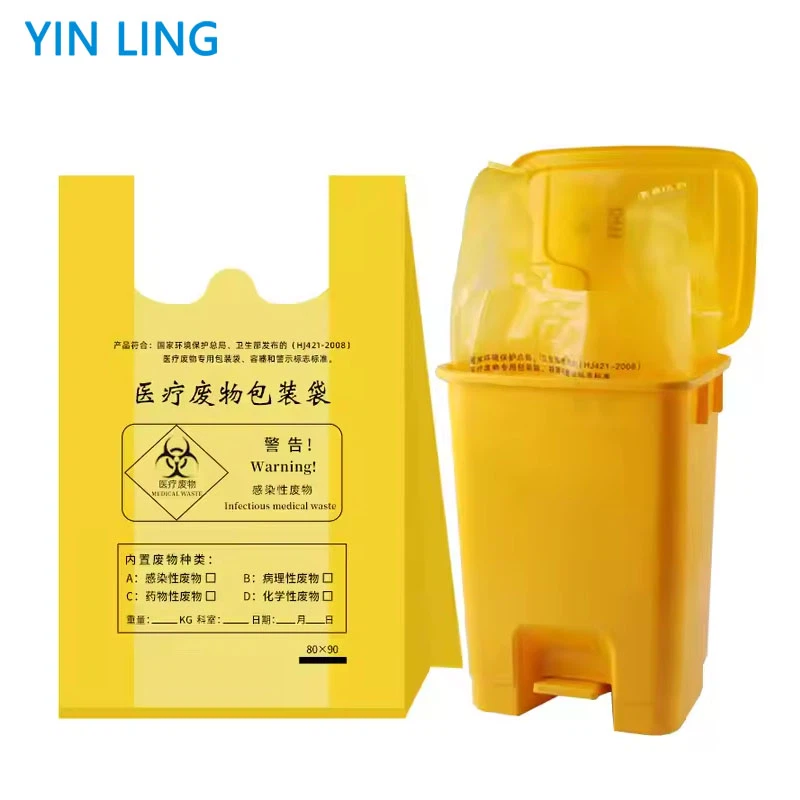
For more specialized applications, we have the Yellow Garbage Bag for Hospital Waste. These bags are specifically designed to handle hospital waste, which may include biohazardous materials. They are made from thicker and more durable plastic to ensure safety and prevent leakage. Due to their thicker construction, they may have a slightly higher density compared to regular trash bags, but they can still float when empty. However, when filled with heavy medical waste, they are more likely to sink.
We also offer Rolled Garbage Plastic Bags. These bags are convenient for use in trash cans with a liner dispenser. They are usually made from a continuous roll of plastic, which is cut into individual bags as needed. The thin and lightweight nature of these bags makes them highly likely to float on water when empty.
The floating ability of trash plastic bags has important environmental implications. When plastic bags end up in water bodies, such as rivers, lakes, or oceans, those that float can be carried long distances by currents. This can lead to the spread of plastic pollution over large areas. Floating plastic bags can also pose a threat to marine life. Animals may mistake the floating bags for food and ingest them, which can cause internal injuries or blockages in their digestive systems.
On the other hand, sinking plastic bags can also cause problems. They can accumulate on the bottom of water bodies, where they can smother aquatic plants and animals. The decomposition of plastic bags in water is a very slow process, and over time, they can release harmful chemicals into the environment.
As a trash plastic bag supplier, we are aware of these environmental concerns. We are committed to promoting the proper use and disposal of our products. We encourage our customers to recycle plastic bags whenever possible. Recycling helps to reduce the amount of plastic waste in the environment and conserve natural resources.
In addition to environmental considerations, the floating ability of trash plastic bags can also be relevant in some industrial applications. For example, in waste management facilities, the ability to separate floating and sinking waste can be useful for sorting and processing. If a large amount of trash plastic bags are floating in a water - based sorting system, they can be easily skimmed off the surface, which simplifies the sorting process.
If you are interested in our trash plastic bags, whether it's the Drawstring Garbage Bag, Yellow Garbage Bag for Hospital Waste, or Rolled Garbage Plastic Bags, we would be more than happy to discuss your specific needs. Our team of experts can provide you with detailed information about the products, including their properties, sizes, and prices. We are dedicated to providing high - quality trash plastic bags at competitive prices.
Contact us today to start a conversation about your trash plastic bag requirements. Whether you are a small business, a large corporation, or an individual looking for reliable waste management solutions, we have the products and expertise to meet your needs.
References
- Callister, W. D., & Rethwisch, D. G. (2011). Materials Science and Engineering: An Introduction. Wiley.
- Moore, C. J., & Phillips, C. A. (2008). Plastic Debris in the Open Ocean. Marine Pollution Bulletin, 56(11), 1259 - 1266.
- Thompson, R. C., Moore, C. J., vom Saal, F. S., & Swan, S. H. (2009). Plastics, the Environment and Human Health: Current Consensus and Future Trends. Philosophical Transactions of the Royal Society B: Biological Sciences, 364(1526), 2153 - 2166.


